Your handheld router can transform into a professional slab-flattening machine with a properly built router sled—but most DIY attempts wobble, drift, or deliver uneven surfaces. How to make a router sled that actually works comes down to three non-negotiables: absolute rail parallelism, rock-solid bridge rigidity, and sub-millimeter depth control. Whether you’re flattening a 6-foot live-edge walnut slab or a thick cutting board, this guide delivers a repeatable system. Forget flimsy plywood frames that warp within weeks; we’ll build a jig that maintains 0.005″ precision for years. You’ll gain the exact techniques for surfacing oversized workpieces that won’t fit through standard planers, saving hundreds on commercial alternatives.
Step 1: Build a Warp-Proof Base Frame for Your Router Sled
Start with a base that won’t flex under heavy slabs. Cut 3/4-inch MDF or Baltic birch plywood 4 inches larger than your biggest workpiece—aim for 48″ x 24″ for most home shops. Underneath, glue and screw a grid of 1.5″ x 1.5″ hardwood strips every 12 inches to prevent sagging. Drill 1/4″ threaded inserts on a 6-inch grid pattern across the top for versatile clamping. Crucially, seal the entire platform with 2-3 coats of polyurethane or epoxy; unsealed MDF swells in humidity, ruining precision within weeks. Test rigidity by standing on the corners—if it flexes more than 1/16″, add diagonal bracing. This foundation handles 100+ pound slabs without distortion.
Critical Rail-Height Calculation
Set your guide rails 1/8″ above your maximum workpiece thickness. For example, if flattening 2″ slabs, mount rails 2-1/8″ above the base. This ensures the router bit clears the workpiece while maintaining downward pressure. Use a digital caliper to verify height at multiple points before final installation.
Step 2: Install Perfectly Parallel Guide Rails on Your Sled

Your rails dictate surface quality—deviation must stay under 0.005″ (the thickness of a human hair). Mill dead-straight reference edges on your base using a track saw. Space rails 2-3 inches wider than your router base diameter (typically 12-24″ apart). Budget builders use 1.5″ aluminum T-track ($50-$80), while premium builds require 2×2″ precision-ground steel tubing ($120-$200). Clamp rails temporarily, test bridge movement, then secure with carriage bolts. Verify parallelism with a dial indicator: mount it on your bridge, slide the length, and adjust shims until deviation is ≤0.005″.
Avoid This Costly Rail Mistake
Never skip the temporary test fit. One woodworker wasted $200 on steel tubing because he bolted rails directly—only to discover binding when the bridge hit a 0.010″ high spot. Always check at 6″ intervals across the entire length.
Step 3: Fabricate a Wobble-Free Mobile Bridge
Your bridge carries the router and must eliminate deflection. Use 1.5″ aluminum box section or laminate two 3/4″ Baltic birch plywood pieces. Route channels for four sealed-bearing wheels with eccentric bushings—these let you fine-tune pressure to eliminate wobble. Install wheels so they contact rails at three points: two on the bottom and one on the side for lateral stability. Test by pushing the bridge along rails; it should glide silently without binding. If using UHMW plastic runners (budget option), wax them weekly to maintain smooth movement.
Router Mount Plate Test
Drill a 6″ x 6″ aluminum plate with a 2″ center hole and router-specific mounting holes. After mounting your router, apply downward pressure—you should feel zero flex. If the plate bends, upgrade to 3/8″ thickness.
Step 4: Add Sub-Millimeter Depth Control to Your Router Sled
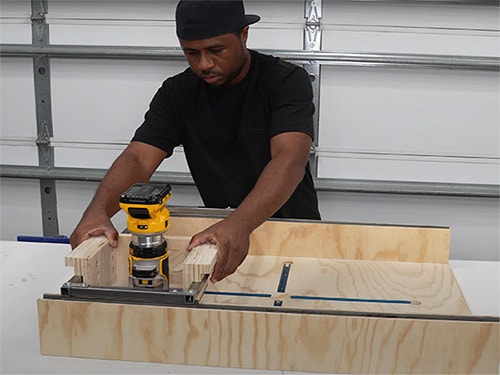
Precision depth adjustment separates pro results from amateur attempts. Install a 3/4″ acme threaded rod with bronze nut for backlash-free movement. Add thrust bearings at both ends and a 6″ aluminum hand wheel marked in 0.001″ increments. Calibrate using precision gauge blocks: rotate the wheel exactly 1.000″ and verify 0.200″ vertical movement. For critical work, add a $200 digital readout (DRO) with 0.0005″ resolution. Lock settings with brass thumb screws to prevent drift during cuts.
Router and Bit Selection: What Actually Works for Sled Surfacing

Skip underpowered routers—they’ll bog down on hardwood slabs. You need minimum 2.25 HP continuous duty (3+ HP for oak/walnut), 1/2″ collet, and variable speed (8,000-24,000 RPM). Top picks: Porter-Cable 7518 (3.25 HP, $350) or Festool OF 2200 (3.5 HP, $670). Always use 2-3″ carbide insert surfacing bits ($80-$150)—replaceable knives last 10x longer than brazed bits and deliver glass-smooth finishes. Never exceed 2″ bit extension; instability causes chatter.
Critical Bit Safety Check
Before every use, inspect cutters for cracks under bright light. A single fractured carbide tip can become a dangerous projectile at 18,000 RPM.
Step 5: Flattening Technique That Avoids Common Pitfalls
Shim unstable workpieces with plastic shims until rock-solid, then clamp all four corners. Set initial depth to 0.020-0.050″—never deeper. Start in a corner moving against bit rotation (climb cutting), maintaining 1 inch per second feed rate. Overlap passes by 50% of bit diameter. After each full pass, check flatness with a 36″ straightedge; gaps >0.005″ need another pass. Final passes at 0.010″ depth eliminate tearout. Hardwoods like maple require slower feed rates than pine to prevent burning.
Fix These 5 Router Sled Problems in Under 10 Minutes
Chatter marks? Tighten all mounting hardware and replace dull bits—never ignore vibration. Burning wood? Increase feed rate immediately; slow movement overheats fibers. Bridge binding? Clean rails with mineral spirits and adjust eccentric bushings. Depth drift? Re-tighten thrust bearings on your acme rod. Workpiece shifting? Add toggle clamps at midpoints—F-clamps alone often fail on wide slabs. Always test fixes on scrap wood before resuming your project.
Non-Negotiable Safety Rules for Router Sled Operation
Wear ANSI Z87.1 safety glasses, P100 respirator for MDF dust, and anti-vibration gloves. Install an emergency stop switch within arm’s reach—never operate without it. Critical rule: Always secure workpieces on all four sides; kickback from a 3″ surfacing bit can launch a 50-pound slab. Test every setup on scrap material first—one mistake on expensive wood costs more than your entire sled build. Never wear loose clothing near the spinning bit.
Your router sled will become indispensable for live-edge projects and oversized work. Build it with these precision-focused steps, and you’ll achieve results rivaling $5,000 commercial machines. Remember: the difference between frustration and flawless surfaces lies in rail parallelism, bridge rigidity, and depth control—master these, and you’ve conquered how to make a router sled that delivers. Store disassembled in climate-controlled space to prevent wood movement, and recalibrate quarterly for decades of reliable service.